Wednesday, September 3, 2008

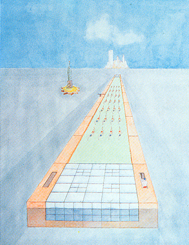
Public Farm, Work AC


Urban farms tend to oscillate between the polar extremes of totalizing urban systems (think Broadacre City) or isolated individuals diligently planting their terraces and sills (or the lone agrarian avenger seedbombing the destitute and vacant lots of our fair cities). Work AC’s Public Farm is sitting somewhere uncomfortably in the middle.

I like to think of it as a piece of driftwood—a misplaced fragment that tells the story of an extensive dendritic network, for it is the farm’s status as a complete architectural object that bothers me the most about the farm’s realization. Work AC’s reference to Superstudio’s Continuous Monument and Koolhaas’ Exodus seems to have been manifested primarily in a strong geometric form – a simple rectangular geometry with prismatic voids. At the scale of the PS.1 installation these gestures of monumentality seem quite diminutive. That is why I would prefer to have seen it treated as an all-encompassing infrastructure—perhaps referencing some of Superstudio’s other projects (see images below).

The primary element of the Public Farm contains all of the genetic code necessary to imagine the farm as a larger, more pervasive infrastructure. If so it could have avoided the ad hoc nature of the rest of the installation, which leaves a lot to be desired. The Public Farm’s repetitive module is easy to fabricate and install, and it is flexible enough to respond to singularities in topography and urban form.

Indeed, the strongest part of the design is its ability to operate across the multiple scales of furniture, architecture, and urbanism through a simple, direct formal gesture. One could imagine it as the connective tissue and iconographic symbol of a community in the way that Siza used water infrastructure in his Quinta da Malagueira social housing in Evora, Portugal.

The Public Farm is an ultra-witty piece of design, full of little tricks and gadgets to remind you that urban farms can not be thought of along the same lines as our grandparents’ pastoral landscapes but must be augmented, modified, digitized. The farm becomes urbanized through technology and persistent themes of voyeurism and artificiality.

In the end one can see the Public Farm as a reference to another one of Koolhaas’ early projects: the swimming pool featured in Delirious New York. Much like the swimmers trying to cross the Atlantic, society is now looking back to our agrarian past in order to figure out how to move forward.

Postlude: It’s been a few months since I first wrote about AgroURBanism and since then the press coverage of the subject has really blown up! It is all too much for me to really keep up with, hence my lack of recent postings on it. A couple of months ago I had the chance to check out this summer’s warm up installation, Public Farm 1 by Work AC which I wrote with reference to in that earlier post. This is kind of old news but I have been meaning to write a review of it ever since. This is now a work of historiography because the installation has been dismantled. But I thought it would be good now to write some thoughts about it since I have actually seen the artifact first hand.

See Previous: AgroURBanism 1, AgroURBanism 2

Tuesday, September 2, 2008

Sustainable Irony

aka my depressing thought of the day


In today’s economy the ‘green’ rhetoric appears to be growing at a rate inversely proportional to the amount of ‘green’ projects getting built.  As the global economy deteriorates rising construction costs, investment fears, and amplified value engineering will increasingly reduce our great green dream.  At the same time, developers needing to improve ever diminishing returns will market themselves as more and more sustainable resulting in the persistent thinning of the green veneer.

The more you scream the less you get.


Thursday, August 28, 2008

China Postcard


China Postcard, originally uploaded by o d b.

Hello from China!
Beijing Welcomes You!
and Dave does too.
the weather is beautiful (sometimes)
the scenery is nice
the people are friendly
what happens in BJ stays in BJ!
until it gets exported
wish you were here
xoxo
Dave

Tuesday, August 26, 2008

Discussion of the Week: SimpliCity vs. ComplexCity

One of our primary interests here at _URB_ is fostering discussion on issues relevant to urbanism and its related fields: architecture, landscape, and design. To help facilitate a more discursive atmosphere we are starting a new section featuring discussion topics that will be open to debate for one week. Please check in at the beginning of each week for the new topic. Also, if you have topic suggestions please do not hesitate to contact us.

Topic #1: SimpliCity vs. ComplexCity
The first topic that we would like to bring up for discussion is a debate between complexity and simplicity in the city. From the early moments of Postmodernism complexity has been celebrated as a worthwhile objective in both architecture and urbanism while the seemingly simplistic nature of the urban plans of the Modernists was vilified. Prior to Postmodernism the dissatisfaction with Modernist urban planning dogma had been growing for some time and is best exemplified in popular culture by the films of Jacques Tati such as Playtime and Mon Oncle. (1) In architecture the first signs of discontent began with the Team X group but it was perhaps not until Venturi first uttered the phrase “Less is a Bore” in Complexity and Contradiction that the floodgates of dissension were fully unlocked. Thus began what can beset be described as a disciplinarian full-court press in pursuit of the proper form of complexity that could overcome the damage that the elementarist attitude of the Modernists. (2) Rowe and Koetter’s Collage City, the research into the signs and systems of the ‘ordinary and ugly’ of Venturi and Scott Brown, the indexical mappings of Eisenman, the overlapping grids and fragmentation of deconstruction, and the montagic operations of Koolhaas/OMA were all attempts to imbue urbanism with the plurality, density, and ultimately the complexity that was determined missing from the Modernist City.

Over the last few years a new approach has developed, which is even known as the ‘Complexity Project.’ The complexity project’s most internationally recognized practitioners would be Hadid and Schumacher, but the group also includes firms such as Reiser + Umemoto (RUR), UN Studio, FOA, and countless other young practitioners. It is primarily associated with schools such as the AA in London (the DRL, EmTech, and Landscape Urbanism units in particular), Columbia University in New York, and the Angewandte in Vienna. In other words there is a tremendous amount of research and intellectual resources devoted to the Complexity Project.

The Complexity Project’s theory is based on a scientific understanding of complexity and is therefore related to computational, algorithmic, behavioral, and systems based approaches and ideas of emergence and self-organization. The complexity project is characterized by the use of advanced geometries such as Voronoi and Delaunay scripts; parametric software and the use of associative geometry are used to create fluid forms; and computational logics are used to digest massive amounts of information.

With these techniques they claim to trump both the mechanical approach of the Modernists and Postmodern’s rudimentary attempts at complexity. RUR claim that collage is the “accumulation of the merely different” and reject it in favor of “progressive differentiation” in their search for a “new conception of the universal.” This approach pushes for systems of variation rather than systems of variety. Hadid and Schumacher promote the concept of Parametric Urbanism and have developed techniques such as soft grids, fields, and pliant surfaces as a way to bring added richness to the city, although their strictly formal approach can be argued as not adequately contending with the real complexity of the city.

Recently I have been wondering if the Complexity Project is the appropriate response to the already overwhelming complexity of the contemporary metropolis. I wonder if we as designers should not be developing strategies to make them less overwhelming and more comprehensible. Using John Maeda’s concept of simplicity I wonder if we can come up with an idea for the SimpliCity. Recently there has been a backlash of sorts in response to the ComplexCity project. Some people argue that the diagrammatic fluidity of some of their projects belie a paradoxical lack of flexibility in the final fom--in it's use and adaptability. Groups like Dogma in Europe have been arguing for more formal autonomy and strong, identifiable geometry. This might be an initial way of understanding what the SimpliCity could be. I would also like to point out the progress of product design towards simpler interfaces and minimal design, Apple’s iPod being the perfect example (or think of virtually any Apple product compared to their competitors). In pop culture we might look to the evolution of the robot as demonstrated by Wall-E and Eva.

So now I would like to ask all of you, what do you think of the idea of the SimpliCity? What would it be? How would it operate? Would it create a desirable city or is the notion of complexity more appropriate for unleashing the potential of the city? How can we utilize simplicity without falling in the same traps as the early modernists?

In addition to these questions I am also providing some images below for visual stimulation. I cannot wait to hear what you all have to say!

1. Jane Jacobs' The Death and Life of Great American Cities is obviously another example.
2. Best described in the first chapter of Reyner Banham's Theory and Design in the First Machine Age.

Monday, August 25, 2008

NYT - Curious World of the Last Stop

Over the weekend there was a great article in the New York Times which surveys every last stop on all the subway lines in NYC. It is supplemented by a super interesting interactive page featuring maps, photographs, videos, and interviews (see screen shots below). Is it just me or is NYT really taking these interactive features to the next level lately?

Here is some of the text by Andy Newman from the article:

At the city’s often-threadbare fringes, there is an inescapable sense of lonesomeness. There might be a Last Stop Deli, a forlorn bar, a maintenance yard populated mostly by rows of empty trains. There is, surprisingly often, a cemetery.

Yet to visit all the system’s extremities is to see that the last stop is not a single, monolithic place. There are subway lines that end, logically, where the city runs out of land; lines that end, anticlimactically, where builders ran out of money; even a few that fetch up in bustling downtowns of one sort or another. From the marshy lowlands of Tottenville to the lush hills of Riverdale to the ceaseless clangor of Flushing, the end of the line manages to take in the entire breadth of the city beyond Midtown Manhattan.

Photos by Richard Perry via NY Times

I have to mention that some of the photographs remind me of some of the "not last stops" of some of the subway systems in cities like Atlanta, GA, where, particularly on the south side of the city, some of the stations exist in desolation, quarantined from the urban areas they are intended to serve by other infrastructure or vast parking lots catering to that city's culture of auto-mobility.

Below is a diagram I produced last year showing why MARTA stations in the city of Atlanta produce the island effect:

It makes me wonder what Disney could do at these locations?
NY Times article found via Planetizen

Sunday, August 24, 2008

ImaginURBanism

Walt Disney World - Magic Kingdom

In the past whenever I heard the term ‘Disneyfication’ I always assumed it was used to describe negative transformational processes—particularly when it comes to the city. It connotes such thoughts as triviality, immaturity, and the giving up of authenticity to the onslaught of pure market-driven city building. We all remember what happened to 42nd Street, right? There used to be a darn good strip club where that Lion King theatre now stands!!

But I was reading Reyner Banham’s wonderful book on Los Angeles recently, The Architecture of Four Ecologies, and his chapter on the architecture of the fantastic caused me to rethink my misgivings towards the process of Disneyfication. Banham makes the argument that Disneyland has created a ‘transportation fantasy’ in which almost every mode of transit known to man exists in a complex interwoven tapestry of mobility. Banham writes that

Ensconced in a sea of giant parking lots in a city devoted to the automobile, it provides transportation that does not exist outside – steam trains, monorails, people-movers, tram trains, travelators, ropeways, not to mention pure transport fantasies such as simulated space trips and submarine rides. Under-age children…enjoy the license of driving on their own freeway system and adults can step off the pavement and mingle with the buses and trams of Main Street in a manner that would lead to sudden death or prosecution outside.

'The Lake' from Reyner Banham's The Architecture of Four Ecologies

One photograph of Disneyland featured in the book shows a monorail, a rollercoaster, a funicular, and a submarine all within the space of one frame. Which leads me to wonder—what if Disney’s Imagineers – the group in charge of the planning, design, engineering, and implementation of all of the Disney corporation’s theme parks and the not-so-tiny cities of hotels, restaurants, and support areas which are developed on Disney properties – created a consulting agency to teach cities how to create better mass transit systems. For, as Banham pointed out back in 1971, “Walt Disney was the only man who could make rapid transit a success in Los Angeles.” How much more efficient and well-executed would our transit systems become? How much more fantastic would our daily commutes be?

What if…

…We took it one step further and suggest that the Imagineers create their own urban design firm and begin designing the future cities of the world. They could develop a theoretical framework for their design—it could be called ‘ImaginURBanism’—and it would be the latest fad of city design for UAE sheiks and prominent Asian businessmen to commission and endorse. ImaginURBanism would blend high-end technical wizardry with thematic kitsch in a way no other urbanist could keep up with. “But wait,” you find yourself asking, “isn’t that what they are already doing over there?” Umm…yeah…good point!

The first question an ImaginURBanist asks a new client is “What’s your pleasure—Wild Wild West, or FutureLand?” The adventurous type might go for a swashbuckling dose of Pirates of the Caribbean. The megastructuralist would wholeheartedly endorse the Swiss Family Robinson treehouse—never has Kenzo Tange’s metabolism metaphor been taken quite so literally!

Or maybe the imaginURBanists would get back to their roots. The term ‘imagineering’ was given birth in the research labs of WWII as a combination of the words imagination and engineering. Imagineering was originally defined as "the fine art of deciding where we go from here.” (Wiki) Urbanism is often described as the art of scenario making—in a way urban design can be thought of as designing a stage for the future play of life to be enacted upon. Koolhaas has described his efforts at urbanism as being a ‘scenario-ist’ and a ‘script writer’ (see this interview with Charlie Rose). When thought about in that way, Imagineering and urban design are not so different. The Imagineers could potentially represent the most capable group of multi-disciplinarians ever formulated, and therefore the ImaginURBanists would be in a unique and fertile position to imagine the future potential of cities.

Would it be so different…

Archigram's Instant City

...From some of the zany utopian projects so popular among the architecture avant-garde of the 1960’s? Two of Archigram’s projects, Ideal Circus and Instant City, for example, are essentially travelling amusement parks that would travel among small towns to create an ‘event’ that would resemble the spontaneity and choice that is a result of the polyprogrammatic city. Peter Cook writes that “the town would be a City for a week—a city in terms of Event, sophistry, and offering.” When I was growing up in a small suburb in Georgia, I fondly remember the recurring event of the McNair Fair. Once every year or so the fair would come to town greatly increasing the town’s potential. Mobility is another theme that connects Archigram to the Imagineers. Both Ideal Circus and Instant City are mobilized urbanisms intended to create a network out of previously unlinked townships. Instant City, the more ambitious of the two projects, was a complex assemblage of trucks, inflatable tents, and dirigibles—in fact the circuit itself is intended to be part of the event. Perhaps the Imagineers could bring some of these future visions from the past to fruition.

'Canal City', by Jon Jerde, Fukuoka Japan, from You Are Here

Or would a city designed by the Imagineers be so different from an entire city designed by someone like Jon Jerde, or even Frank Gehry? Most laymen would probably not be able to tell the difference between the resultant designs. All would be shiny, wonky, and look like some incredible village from the future. Maybe it’s telling that they are all from Los Angeles—there must be something in the water they drink, the air they breathe, and the dirt they play around in that makes them all turn out that way.

Collage of Frank Gehry Projects

Lest we forget…

“Disneyfication…not only provides a fictional and often nostalgiac identity, but…also is purposely designed to brek the contingency of public space that is characteristic of urban culture, replacing it with a domesticated family friendly scenography of—often commercially controlled—pseudo-public spaces.”

So says Martijn de Waal about the downside of the Disneyfication process. It can be read as a cautionary tale about one of the potential downfalls of the ImaginURBanist dogma. Every future imaginURBanist must therefore remain focused on the original conception of Imagineering and not allow it to become a mere tool of developers in their not-yet-proclaimed war on the public spaces of our urban areas. As a method of keeping themselves in check an additional tenet to the ImaginURBanists doctrine could be this quote from Koolhaas: “Cities accumulate everyone’s desires; therefore they form the richest accumulation of potential for every individual to be himself or herself.” When combined with the Imagineer’s orginal mandate--the fine art of deciding where we go from here—ImaginURBanism might become of the most fecund '–isms' of urban design’s recent history.

Friday, August 22, 2008

LWB: Dude you totally stole my future blog idea!

picture via io9
I totally had one of those "Dude, you totally stole my future blog idea" moments tonight when I read Life Without Buildings post on megastructures and science fiction which totally made me scream out loud "Dude, you totally stole my future blog idea." I mean, c'mon dude, you totally stole my future blog idea. And you probably did it better than I ever would, which really sucks for me. But for now I can just highly suggest to all of you out there that you should check out this really cool post on megastructures, ship breaking, and starships.


His post was based on this post from io9, which I haven't had the chance to read yet. And it also reminded me of this incredible article on the relationship between urban design and cinematic cities called Architectural Representations of the City in Science Fiction Cinema.