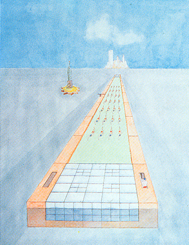
Callebaut - LilyPadSunday, September 7, 2008
Aqua-Plagiarism
Callebaut - LilyPadGeo-Mimicry 2B :: Catalogue of Projects
....And finally: the new Geo-Mimicry projects!
Rather than do a typical post I decided to create a flickr set that indexes the Geo-Mimicry movement. This set will be continually updated so check on it often. Let me know if you come across projects that should be included in the set or if you would like to have your own project included.
I am still working on a way to categorize the projects. If you have any thoughts on how to do it leave me some comments!
I hope this set of eye-candy makes up for the two previous super long-winded posts. I even won an award on an Archinect discussion for best archi-babble! Thanks guys, I'm really touched...
Previous posts:
Geo-Mimicry 2A :: Beginners / Begetters
To begin showing the projects of Geo-Mimicry I thought I would start by showing some of the historical precedents of geologically inspired architecture of the past. Now this could go waaaaay back in time because geology is something that has continually inspired architects through the ages. Indigenous peoples of almost every continent developed a form of architecture related to the geology of their region, as the following images from Mesa Verde, Chaco Canyon, and Tibet demonstrate.
But the point of this post is not really to create a historical trajectory tracing geo-mimetic architecture from the annals of history to present time--for geo-mimicry is kind of like what Frank Gehry famously remarked about his use of fish for inspiration: it references something beyond the history of architecture in an attempt to create something new (it is therefore extra-disciplinary)--it is merely to demonstrate that geo-mimicry is really nothing new at all. The difference now is that it appears to have reached a central point in our disciplinary discussions, whereas in the 20th century it might said to have occupied a more peripheral role architectural discourse.In the early 20th Century Geo-Mimicry developed a small but devout following as part of the larger Expressionist movement, particularly in Germany, Austria, and Switzerland. This sets up one of our modern trajectories of geo-mimicry, which tend to operate more geographically than chronologically. I'm going totally out on a limb here, but I would venture to guess that geology was put into the minds of architects by the growing number of expeditions and explorations of virgin geographies in the 19th Century, which were glorified and put into the popular zeitgeist by artists like Caspar David Friedrich, and his painting Das Eismeer (The Sea of Ice), from 1823 – 1824.
In expressionist architecture, it was Bruno Taut that would make the greatest argument for geo-mimicry with his book Alpine Architecture: A Utopia, and the amazing drawings and etchings published as part of the book. Taut's alpine architecture was faceted, crystalline, and resembled the Alps. The amazing Taut appears to have come back from the grave to create a MySpace account from which he shares a few tidbits about his ideas:My plans for an Alpine Architecture really took off—it was basically this utopian vision of a world where the natural landscape would be beautified by buildings/sculptures of illuminated colored glass, and these structures would bring people together despite class or national differences and be a means of spiritual renewal. Soon a new society could form, a non-hierarchical and integrative collective.
Unfortunately Taut only realized a couple of works that resemble some of the fantasies of his Utopian Alpine vision. The most famous of which is the Glass Pavilion constructed as part of the Cologne Werkbund exhibition. Again, from his MySpace page, Taut continues:All you architect scholars out there won’t chill out about my Glashaus (glass pavilion) at the Cologne Werkbund exhibition in May…but it was pretty cool…I made a kind of prismatic dome with colored glass (it even had a waterfall in it!) as a tribute to a new architecture that combines monumental function and fantasy.
Skipping ahead a few years we come to Gunther Domenig, and Austrian architect who spent years working on his personal utopia--his very own house called Stein Haus. Steinhaus--Stonehouse is a book published by the AA to commemurate the home, which "tells the story of the conception and construction of a home cum studio cum intellectual haven for the architect in a landscape which has been part of his personal memory bank of images since childhood." This landscape is the remote mountain landscape of rural Austria. You can see another amazing photo of this house here on Flickr.
Another recent example of the Austrian trajectory is Hans Hollein's project for the Vulcania museum in Auvergne, France. This project represents a low point for the geo-mimicry project, for it is an example of the simplest form of easy-to-consume Disneyfied geo-iconography--you mine as well put some fake lava and smoke plumes in there to finish it off. Although I have to admit it did result in an interesting space within the sheared conical structure--I just wish it wasn't meant to actually represent a volcano. It's a little 1:1 and closes off other interpretations. But that opens up another can of worms that I am not very well qualified to speak about.
Hollein, VulcaniaAnd now we move from the European front to the New World to look at the other geographical trajectory--the American Southwest, best exemplified by Antoine Predock.

In my previous post on Geo-Mimicry I stated that Vicente Galluart might be the best example of a geological architecture. I might be eating those words today. Predock has been honing his special blend of geological architecture for some time now, and rarely strays from this path, despite an increased global production from his previously regional practice in New Mexico. This is one of the great things about geo-mimicry--since you are claiming the Earth as your primary context and source code, you can apply it anywhwere (see images below--projects from New Mexico, Minnesota, and China). Predock describes this when he says
New Mexico has formed my experience in an all-pervasive sense. I don't think of New Mexico as a region. I think of it as a force that has entered my system, a force that is composed of many things. Here, one is aimed toward the sky and at the same time remains rooted in the earth with a geological and cultural past. The lessons I've learned here about responding to the forces of a place can be implemented anywhere. I don't have to invent a new methodology for new contexts. It is as if New Mexico has already prepared me. (emphasis mine)
Predock's writings on architecture to me are probably the best example of what Geo-Mimicry in architecture could be. He discusses a lot of the topics I put forth in the previous Geo-Mimicry post. I still feel like his work is more about a formal resonance with geology, rather than what a process based approach would be, but it is still compelling. He speaks about the aspect of geological time when he writesWhen I am working on projects with my team ...we remind ourselves that we are involved in a timeless encounter with another place, not just a little piece of land. All of the readings that have accumulated and been assimilated there, that are imagined there, that may happen there in the future — all of these collapse in time and become the raw material with which we interact. We are not merely trying to record or express a particular epoch.And he describes the 'deep structure' of geology that I wrote about when discussing highway road cuts. Road cuts are also the space of exploration of John McPhee in his series of books on North American geology. Predock relates them to architecture when he writes
Critical to the spirit in my work is the enigmatic quality of the desert. You think you've got it, you think you understand; then you turn over a rock or crawl under a larger rock and you discover other worlds, other realms within. In a highway roadcut, for example, a sectional diagram of the earth is revealed through man's intervention. At the bottom of a roadcut in the southwest is pre-cambrian granite, overlaid by limestone…The roadcut is a poetic diagram of an investigative process for the making of architecture.
To close, and to bring the discussion to the present day (although Hollein and Predock are both still active, I don't think they occupy a central role in the contemporary discussion on geo-mimicry) I close with two projects that, because of their mass appeal and wide publication, made it safe to talk about rocks again in contemporary architecture. Although I'm sure this was not their intention, for neither of them are really about rocks and geology at all, they just look like rocks, and they are both often referred to as rocks. So here goes...
OMA's Casa de Musica and Aranda/Lasch's Grotto project. One paved the way for building's that are strangely contextual despite the fact that they look nothing at all like their surroundings and one made it safe for the digital exploration of rock-like forms.
Thursday, September 4, 2008
Geo-Mimicry
Note: This post is broken down into two parts. Today's post will be primarily a textual description of the recent use, and future potential of geology in architecture and urbanism. The next segment will feature a series of projects illustrating the discussion.
Architecture might be said to have a mimcry complex. No, I'm not referring to a psychological affliction. I'm using it the phrase the way that evolutionary biologists use it - to refer to the collective act of a group of organisms, mimics, evolving to share common perceived characteristics with another group, the models.
Or maybe it is a mimesis complex? (and by this I do mean it psychologically) Plato and Aristotle's description of mimesis as the representation of nature in search for truth by the carpenter and the artist can be spread to architecture. For as long as architecture has existed mimesis has been used as a common technique by architects for the production of architectural form.
In the beginning was automimicry - one popular theory states that the stone details in ancient Greek temples were built to resemble vernacular wooden structures. In this case architecture mimics architecture. Then mimicry slowly crept into architecture's foundations - literally - as the use of rusticated stone and quoins were used to represent the earth growing to form a building's solid base during the renaissance. Much more recently biomimcry has been a technique used by architects. On the one hand by ecologically minded designers who want to imitate natural processes to produce sustainable architecture, and on the other hand by the avant garde, particularly digital formalists like Greg Lynn, Hernan Diaz Alonso, the Ocean collective, Andrew Kudless, Tom Wiscombe, and others.
In the past few years a new approach has emerged that appears to signal a new mimetic direction in the production of architectural form. Recent projects by architects such as Snohetta, MVRDV, and Vicente Guallarte (this list is by no means exhaustive) all t(r)end to use geological formations as inspiration. While geomimicry is a term used by some to "describe processes and technologies that mimic long term geological processes," these projects tend to use geology as a purely visual metaphor. Which is why I use the hyphenated form of Geo-Mimicry - to distinguish it from the single word geomimicry. I am also careful not to call the projects "geological" in the way that I used "geographical" in the post on New Geographies. For it seems to me they have left the logic part out of the equation (one notable exception could be Vicente Guallart, the designer who appears to be most invested in developing a geological architecture). What I mean by this is that the projects seem to mimic only the aesthetics of geological formations and not the complex processes of geology and geophysics.
But still I am drawn to these projects and excited about the possible new directions it could lead designers. The main reason for this is that it just so happens that I am currently reading John McPhee's Assembling California and I have been thinking a lot about the relationship between geology and design as I read. I think it is a lost opportunity for designers not to think about geology in terms of its processes and less formally, although I have to admit that geo-aesthetics are quite amazing in their intricacy and complexity (despite my recent questioning of the use of complexity in urbanism).
Now, the one question to be answered is why the sudden rash of geological metaphors in architecture?
While I don't know for certain, I do have a hunch as to why geology has recently become such a popular formal metaphor. And I have a couple of ideas of how designers might expand the notion of geo-mimicry.
To start, here are a few reasons why I think that architects might be drawn to geology:
1. Permanence - Any reader of John McPhee will know that the notion of permanence in geology is suspect, but most of us still view mountains and terrain as perpetually static. I think some architects are still drawn to permanence as a virtue, despite (or perhaps because of) architecture's ever-increasing impermanence.
2. Context - This I think is one of the main reasons architects have been mining geology for new material. One of architecture's most common (and easiest?) ways of dealing with context is through mimicry and assimilation. With the increased amount of city building in the untouched regions of the Middle and Far East (UAE, Mongolia, Kazakhstan, etc), it is natural that architects would look to the natural environment for source material.
3. Beauty - Let's face it - rocks just look good! If you don't know what I am talking about just Google any of the following: geology, rocks, geological folding, geodes, or virtually anything else related to geology and see for yourself.
And here's a few ideas of how designers could start thinking geologically to enhance the idea of geo-mimicry:
1. Plate Tectonics - the idea of plate tectonics and all its implications are so full of material for architects it's ridiculous. Here is just one example - I have been thinking of the idea of a geological suture and how it might relate to border conditions in urban areas. In geology the suture is the place where two plates 'dock' together and usually results in the most remarkable topography and rock formations. Sometimes the suture can be as wide as 50 miles. How might the idea of a suture be applied to urban design? Can the notion of an exceptional, thickened border with amplified intensity in form and program be an antidote to gated communities and other walled-off enclaves segregating our cities?
2. Transformation - We designers love thinking about form as part of a transformational processes. Since the earth is actually in a state of perpetual motion, the process of this motion and the morphological impacts it has on geological formations are full of interesting architectural metaphors: collision and convergence, spreading centers, subduction, shearing and strike-slip faults, transform faults, convergent/divergent margins, just to name a few.
3. Temporality - McPhee often speaks of the asynchronicity of geological time and human time. Sometimes though they can synch up, often to disastrous effects. Thinking about temporal variety can be useful in urbanism for manifold reasons: when thinking about the disparate time frames of urban districts (their metabolism, if you will), the processes of urban transformation (political time vs developer time vs implementation time, etc), or just to put everything in chronometrical perspective. Also, geological time is not linear or consistent-- temporal uncomformities and simultaneities abound and the results are rarely predictable. Additionally, geology is essentially an act of reverse engineering--figuring out what happened to the world, when, and how. The more we understand about this, the more we can project what will happen in the future. I think this is another way to think about the relationship between the disciplines of geology and design.
4. Deep Structure - The recent fascination with landscape in design has lead to thinking about architecture in terms of surface and topography. In geology, "one must develop a talent for seeing through the topography' and into the rock on which the topography was carved." (McPhee) Thinking geologically forces designers to think fully three-dimensionally construct mental maps of terrane. For rocks, "their unit-to-unit relationship--their stratigraphy and other juxtapositions--pondered as a whole is structure." (McPhee)
Literary Dystopias and Green Utopias
LITERARY DYSTOPIAS
I’ve come across two articles on Dystopian visions of the future this morning that both refer to a bunch of dystopian literature. Since I have not read or heard of most of them I thought you might be interested also.
First, io9 features an article in their Liberal Dystopias segment called “Best Future Dystopias Where the Liberals Have Won.” The opening line describes the raison d’etre of the piece:
“The Republican Party is gathering in

via i09
Second, I’m a little slow to this one (its all the way back from January 2008, light years in blogtime), but Adam Greenfield did an interesting piece on dystopian science fiction literature of the 1970’s in his blog Speedbird. Called “Along the Dystopia Line 1: I am your Density” it mainly discusses how SF writers in that period viewed high density urbanization as a pretty disastrous outcome for the human race. I like how he exposes SF’s fears of multiculturalism and cities in general in his description. I wonder if that is still a common trope for SF writers to use.
GREEN AVENGERS and their UTOPIAS

via crosshatchling
Guerilla Gardening has become a hot topic recently, with all the new books (1 and 2) and everything. Archinect offers a great review of the first book called Turf Wars (and Wars on Turf).
And finally, artist Anna Garforth takes guerilla gardening to the next level with her guerilla graffiti gardening (see pic above). Take that you low-level seedbombers!! This is highly cultivated guerilla gardening (pardon the pun).
Wednesday, September 3, 2008
Public Farm, Work AC
Urban farms tend to oscillate between the polar extremes of totalizing urban systems (think Broadacre City) or isolated individuals diligently planting their terraces and sills (or the lone agrarian avenger seedbombing the destitute and vacant lots of our fair cities). Work AC’s Public Farm is sitting somewhere uncomfortably in the middle.
I like to think of it as a piece of driftwood—a misplaced fragment that tells the story of an extensive dendritic network, for it is the farm’s status as a complete architectural object that bothers me the most about the farm’s realization. Work AC’s reference to Superstudio’s
The primary element of the Public Farm contains all of the genetic code necessary to imagine the farm as a larger, more pervasive infrastructure. If so it could have avoided the ad hoc nature of the rest of the installation, which leaves a lot to be desired. The Public Farm’s repetitive module is easy to fabricate and install, and it is flexible enough to respond to singularities in topography and urban form.
Indeed, the strongest part of the design is its ability to operate across the multiple scales of furniture, architecture, and urbanism through a simple, direct formal gesture. One could imagine it as the connective tissue and iconographic symbol of a community in the way that Siza used water infrastructure in his Quinta da Malagueira social housing in
The Public Farm is an ultra-witty piece of design, full of little tricks and gadgets to remind you that urban farms can not be thought of along the same lines as our grandparents’ pastoral landscapes but must be augmented, modified, digitized. The farm becomes urbanized through technology and persistent themes of voyeurism and artificiality.
In the end one can see the Public Farm as a reference to another one of Koolhaas’ early projects: the swimming pool featured in Delirious New York. Much like the swimmers trying to cross the Atlantic, society is now looking back to our agrarian past in order to figure out how to move forward.
Postlude: It’s been a few months since I first wrote about AgroURBanism and since then the press coverage of the subject has really blown up! It is all too much for me to really keep up with, hence my lack of recent postings on it. A couple of months ago I had the chance to check out this summer’s warm up installation, Public Farm 1 by Work AC which I wrote with reference to in that earlier post. This is kind of old news but I have been meaning to write a review of it ever since. This is now a work of historiography because the installation has been dismantled. But I thought it would be good now to write some thoughts about it since I have actually seen the artifact first hand.
See Previous: AgroURBanism 1, AgroURBanism 2
Tuesday, September 2, 2008
Sustainable Irony
aka my depressing thought of the day
In today’s economy the ‘green’ rhetoric appears to be growing at a rate inversely proportional to the amount of ‘green’ projects getting built. As the global economy deteriorates rising construction costs, investment fears, and amplified value engineering will increasingly reduce our great green dream. At the same time, developers needing to improve ever diminishing returns will market themselves as more and more sustainable resulting in the persistent thinning of the green veneer.
The more you scream the less you get.