Showing posts with label "climate change". Show all posts

Friday, December 19, 2008

PHREE_URB 01

What Humanism means to me is an expansion, not a contraction, of human life, an expansion in which nature and the science of nature are made the willing servants of human good.
John Dewey, What Humanism Means to Me
There is no denying the fact that we are entering a new design epoch. We have seen the zeitgeist, and it is green*. While just a couple of years ago you could still claim to not be interested in sustainable design these days those words would be considered blaspheme. Over the past several years a steady stream of design conjecture has given rise to a new design paradigm which attempts to recalibrate the (not so) delicate (im)balance between us (humans) and the rest of the world (everything that is not us or produced by us, but more than likely is probably consumed by us); an attempt to place us within the ecosystem rather than over it.
This demonstrates a much different attitude towards the world and our place in it than has previously been exhibited. According to John Dewey, the great American philosopher, humanism means bending nature to our will. This attitude prevailed during the last couple of centuries and has gotten us to the sorry state of affairs we have arrived at today. Global warming, peak oil, environmental degradation, mass extinction; the list goes on and on. Artists, architects, landscape architects, and urbanists have been rising to these challenges in a methodology that goes over and beyond mere sustainable design. Much like the radical shift in thought from a geocentric to a heliocentric model this means a displacement of humans from the center of the design and development ethos (or at least a sharing of the center?). Over the next few posts I will look at the theoretical underpinnings and various strategies of this new movement, which I am calling:

POST HUMANIST REWILDED ECO ETHICAL URBANISM
(PHREE_U)

More catchy than “sustainable”, right?

*Why green? Why not blue, or white? Are vibrant blue skies and crisp white snow capped peaks also not important?

Monday, November 10, 2008

Al Gore's OP-ED

Al Gore's op-ed in the New York Times echoes a lot of my recent feelings regarding the economic and looming ecological crises we are facing today, albeit wrapped up in a much more eloquent and succint package than I could ever hope to achieve.

Opening with a great argument for change (word of the year!) and plea for a strategic investment in sustainable infrastructure, he follows with a five point plan (the packages pretty bow that wraps it up nice and neat) outlining his agenda.

Here are some of the juicy tidbits:

THE inspiring and transformative choice by the American people to elect Barack Obama as our 44th president lays the foundation for another fateful choice that he — and we — must make this January to begin an emergency rescue of human civilization from the imminent and rapidly growing threat posed by the climate crisis.
...
Here is the good news: the bold steps that are needed to solve the climate crisis are exactly the same steps that ought to be taken in order to solve the economic crisis and the energy security crisis.
...
Here’s what we can do — now: we can make an immediate and large strategic investment to put people to work replacing 19th-century energy technologies that depend on dangerous and expensive carbon-based fuels with 21st-century technologies that use fuel that is free forever: the sun, the wind and the natural heat of the earth.
I encourage you to read the rest for his 5 point plan and more great rhetorical skills.

Saturday, July 5, 2008

Strange Weather Part II - GeoenginURBanism


Fertilize the oceans with iron in order to sequester carbon dioxide; launch fleets of ships to whip up sea spray and enhance the solar reflectivity of marine stratocumulus clouds; use trillions of tiny spacecraft to form a sunshade a million miles from Earth in perfect solar orbit. (Mooney)

As an interesting follow up to the initial “Strange Weather” post from a few weeks ago, this month’s issue of Wired magazine features an article on Geoengineering, the branch of science which explores mega-scale modifications to our planet in order to reverse the detrimental environmental and meteorological damage we humans have subjected our planet to since the start of the industrial revolution. Entitled “Climate Repair Made Simple” the article primarily discusses the work of Ken Caldeira and Lowell Wood, two scientists at opposite ends of the political spectrum who have come to some sort of consensus that a science-fiction inspired intervention of epic proportions may be our last resort at resolving our climate crises. Treaties and regulations can only go so far, they argue, and they maybe too slow in reversing our trends. They think that “the only solution lay with technology: direct, aggressive intervention…to turn down the volume knob” on the global warming problem.
Geoengineers’ two most promising solutions involve the two remaining frontiers left to humanity: the oceans and space. One popular geoengineering proposal is to “inject sulfur dioxide into the stratosphere to reflect a portion of the sun’s rays back into space, thus cooling the planet.” (Mooney) This is the technique suggested by Wood and Caldeira. Wood first proposed this back in the 80’s with his partner in crime Edward Teller, better known for inventing his own environmental catastrophe: the hydrogen bomb. Caldeira, a computer scientist with a green heart, began studying this idea using computer simulations of the Earth during the 90’s in order to disprove Wood’s crazy theories. The only drawback: Caldeira’s simulations proved that geoengineered solutions might actually work.
In an article called “Geoengineering our way out of trouble”, Patrick Huyghe discusses the various strategies of geoengineering and the people/institutions that are at the forefront of this exploration. Another solution proposed by geoengineers “involves dumping tons of iron into the waters of the Antarctic to stimulate plankton growth and thereby absorb the buildup of CO2 and slow greenhouse warming.” (Huyghe) Huyghe points out the controversial nature of geoengineered solutions, even among geoengineers themselves.
The general consensus regarding radical geoengineering schemes is that it's too early to be talking about them--if it's not broken, don't fix it. But the future could well bring a change of mind. ‘Geoengineering may most likely become necessary if looming anthropogenic climate change becomes a disaster that can be avoided in time only by a temporary technical fix,’ notes author Martyn Fogg: ‘Natural climate change might also be mitigated in the more distant future, such as to prevent the next glaciation which, if unrestrained, would bury the wreckage of Northern civilization under several hundred meters of ice. It is also possible to imagine a situation in the remote future where geoengineering is permanently applied to extend the life of a biosphere no longer able to conduct satisfactory homeostasis due to a hotter, more evolved Sun.’

What I think could be interesting for architects and urbanists would be to thing of ways we can start providing geoengineering solutions on a building or city scale. Of course sustainable architecture and urbanism both help to do their part, but I want to speculate on what geoenginURBanism might look like.
In 1960 Buckminster Fuller, famed inventor of the geodesic dome among other things, proposed building a giant dome over the island of Manhattan, in order to create a large scale biosphere. Although living in a super large, climate-controlled interior space for our entire lives (probably on film, a la Truman Show) is probably not a good idea, could we invent a porous membrane that is breathable and only allows good UV rays in and reflects back the bad UV rays? Perhaps this could be a way of combating the urban heat island effect—build a gigantic shading device over the entire city! It could also incorporate PV cells, Wind Turbines, and other power generating devices. It could be a filigree of sustainability.
On a side note, there is renewed interest in Bucky Fuller now due to an exhibit this summerWhitney Museum of New York. Regarding Bucky’s life’s work, curator K. Michael Hays says “We didn’t talk about sustainability in Fuller’s day. But he was trying to develop ways of living that would benefit the largest number of people with the fewest possible resources.”
Early in the 2000’s, Yosuke Obuchi, a professor at the Architectural Association in London, designed Wave Garden as a prototype for an ocean-powered power plant using the piezo-electric effect, which is ” a flexible electric generator, where bending the material or applying stress creates an electric charge.” Just by resting on the ocean this giant surface can generate electric power from the oscillation of ocean waves. What is great about the wave garden is that it turns a technocratic solution into a socio-cultural-technical solution. For this is no mere power plant—on the weekends it has the potential to turn into a vast public park half the size of Central Park. It also fits neatly into our current capitalist system by offering incentives for reducing energy consumption. According to Obuchi:
Demand for the energy the Wave Garden produces on weekdays determines its function on the weekend, when energy consumption declines. If Californians have consumed little energy, they are rewarded: the tiles rise to the surface to form recreational platforms and swimming ponds. But if weekday demand is too high, the garden remains strictly a power plant. Acting as a barometer of energy use, the Wave Garden makes invisible power visible.

What if in addition to its great power and public space generative qualities, the Wave Garden also became part of the geoenginURBanism arsenal—stick some iron panels on that sucker to grow some plankton, inject it with sulfur dioxide, let it whip up some sea spray! Infuse it with geoengineering capabilities! Now, these are just two examples of what geoenginURBanism might be. I’d love to hear from you people out there if you know of other examples or what your think could be a potential for this exciting new branch of urbanism.
(crickets chirping in background)
Umm…Ok, well…here are some definitions from Wikipedia to keep you occupied:
Planetary Engineering
Planetary engineering is the application of technology for the purpose of influencing the global properties of a planet.[1] The goal of this theoretical task is usually to make other worlds habitable for life. Perhaps the best-known type of planetary engineering is terraforming, by which a planet's surface conditions are altered to be more like those of Earth. Other terms used for particular types of planetary engineering include caeliforming,[citation needed] for the creation of an Earth-like atmosphere, and ecopoiesis for the introduction of an ecology to a lifeless environment. Planetary engineering is largely the realm of science fiction at present, although some types of climate change on Earth are recent evidence that humans can cause change on a global scale.
Terraforming
Terraforming is the hypothetical process of deliberately modifying the atmosphere, temperature, or ecology of a planet, moon, or other body to be similar to those of Earth in order to make it habitable by humans.
Geoengineering
Geoengineering is the deliberate modification of Earth's environment on a large scale "to suit human needs and promote habitability". [2] Others define it more narrowly as focusing only on the mineralogy and hydrology of the Earth.[3] The term geoengineering is distinct from accidental anthropogenic climate change.
on Fuller at the

Sunday, June 15, 2008

Water Worlds (aka AquaURBanism)

Tomorrow (or, later today actually) I’m off on holiday to Yangshuo and Sanya for what will probably end up a rain-soaked vacation. Apparently it is already flooded in Yangshuo and frogs and snakes are taking over the streets! Rather than cancel our precariously planned trip we have decided to head straight into the murky waters. In anticipation of this predicament I have decided to write about something that seems to be a hot topic in today’s urban design avant-garde: aquaURBanismTM.

ISAR's HydroNet, winner of this year's History Channel City of the Future contest.

AquaURBanismTM is architecture and urban design that deal primarily with issues of water (duh!). Aqueducts, oil derricks, lily pads, etc, are among the inspiration for this branch of urbanism that has picked up steam in recent years due to predictions that global climate change will result in many of our coastal cities being flooded with at least 1m of water, forcing mass exodus and migration. As such aquaURBanist strategies place an inordinate emphasis on hydrology as a design-driver. We can think of Olmsted's Emerald Necklace as an early precedent for aquaURBanism, demonstrating the link between aquaURBanism and Landscape Urbanist strategies. Recently, AquaURBanismTM has been made famous again by the History Channel’s City of the Future contest (wait…the history channel is doing a city of the future contest?), with aquaURBanism featuring prominently in the both of the winning schemes of the last two years: Iwamoto Scott’s “Hydro-Net” and UrbanLab’s “Growing Water”.

Many of the aquaURBanist projects—but not all, of course—fall in a subcategory of ARCOLOGIES, the branch of design invented by Paolo Soleri and most successful in works of Science Fiction. I have recently become pretty fascinated with the arcology concept, part of the reason why I have picked up an addiction to the SF genre relatively late in life—as in, like, two months ago. Now I can’t get enough of the stuff. I will now refer to Wikipedia for the definition of arcology:

Arcology, from the words "ecology" and "architecture,"[1] is a set of architectural design principles aimed toward the design of enormous habitats (hyperstructures) of extremely high human population density. These largely hypothetical structures,y are often portrayed as self-contained or economically self-sufficient. called "arcologies," would contain a variety of residential and commercial facilities and minimize individual human environmental impact.

Today I am going to bring up three recent aquaURBanist projects that I have happened across. The first is LILYPAD: A Floating Ecopolis for Ecological Refugees, designed by super-young Belgian designer Vincent Callebaut, which was featured in an Archinect showcase feature today. Assuming that millions of people will be displaced by rising flood waters, Callebaut’s scheme is described as a “prototypical auto-sufficient amphibious city”.

LILYPAD, by Vincent Callebaut

In this bio-mimetic vision of the future people will live on gigantic lily pads that will house up to 50,000 people each. Each individual lily pad will have three mountains and three marinas dedicated to separate functions: work, shopping, and entertainment, respectfully, leading one to wonder—where has this guy been? Hasn’t he been filled in on our polyprogrammatic needs? Cross-pollination baby! I want a mountain with all three at once….nah, just kidding. Callebaut describes his project as an “Ecopolis”, updating the terminology of the arcology concept, but in a great moment of branding genius placed eco in front and describes it as a city rather than architecture. All kidding aside, the projects imagery is quite an enticing vision of the future—who would not want to live on a resort—although visually it reminds me more of icebergs and oil derricks than lilypads. Lilypads, to me, would suggest a more horizontal and dispersed aquaURBan conglomeration rather than a single aqualith. All in all it is a very interesting and thought-provoking project. I greatly appreciate his pro-active stance towards the problems we might face in the future and I hope some serious research begins to take place regarding these issues.

Urbanarbolismo: Maps of Spain's Alicante Region

Second, is another project I found on Archinect this week called Urbanarbolismo. As you might gather from its name it is as much about trees and forestation as it is about water. But again, one of it’s primary concerns is water. It should be duly noted that this project is not in any way, shape, or form an arcology project, but rather falls into regional planning territory. Here is the description of Urbanarbolismo from their website (please excuse the Google translation):

Urbanization housing second home in Alicante is one of the main engines of the province's economy, now this process creates a landscape that in the long run is undesirable: it destroys ecosystems, waterproofing the soil reduces water loss and therefore the amount rain… In urbanarbolismo we are working to create a housing development that compensates for the loss of evapotranspiration caused by asphalt, deforestation and wetland drainage. We created a map of the province of Alicante with the best areas to locate these estates that cause rain. We are developing types of housing to reforest the territory.

Whereas Lilypad deals with an excess of water, Urbanarbolismo is confronting the opposite issue: the desertification of natural landscapes due to evapotranspiration, a term used to describe the total amount of water loss due to evaporation and plant transpiration. Urbanarbolism’s goal is to create a symbiotic relationship between urbanization and nature, creating a type of urbanization that produces rainfall and will allow the Alicante region of Spain to be re-forested with indigenous tree species.

One thing I really appreciate about this movement is that they have written an interesting urban manifesto. In Nicolai Ourousoff’s last article in the New York Times he closes with a quote from Rem Koolhaas which asks: “Do you have the right to do this much work on this scale if you don’t have an opinion about what the world should be like? We really feel that. But is there time for a manifesto? I don’t know.” Urbanarbolism has answered with a resounding yes, while making an argument for both better integration between the city and nature, and for a region-specific design movement at the same time. Check out the beautiful maps produced by the group here, which demonstrate a great understanding of the Alicante region. These maps and this approach seems to be influenced by Ian MacHarg's ideas about landscape ecology and a regional approach to urban planning with an emphasis on the integration of natural and man-made systems.


On a side note about desertification, check out this interesting post found on BLDGBLOG about the desertification of China west of Beijing. The photographs resemble what Beijing looks like during the many sandstorms that take place in the spring.
Image of China's Dustbowl, via BLDGBLOG

Finally, I have to put in a word for the grandfather of arcology, Paolo Soleri, and one of his latest projects, SOLARE: Lean Linear City (find the project link in the left hand side of the website). Soleri's design is not solely a work of AquaURBanismTM but I include it here because it's form is very inspired by aqueducts and bridges and the urban megaform straddles a river. According to Soleri:
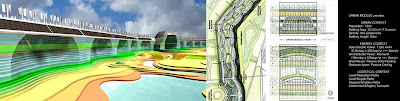
SOLARE, by Paolo Soleri

Solare, the Lean Linear City, is proposed as a possible alternative to the developing technocracy now endorsed and pursued by China.
For us ignorant Westerners, it is almost like witnessing not the rebirth of a nation, but a brand new branch of the human genome falling from the heavens. The suddenness of the metamorphosis, the size of things, and the massive population involved is jolting. One fourth of the planet’s population is taking off! It’s breathtaking, for where it will land is pure guesswork. SOLARE proposes the development of a habitat that may respond to some of the critical situations now taking form in China.

Solare is pure megastructure: an infinitely extendable structure comprised of repetitive modules that house 1500 people each. Soleri's proposal is one long linear strip designed along the length of a river but it would be interesting to speculate how it might bifurcate, coil and self-intersect itself, or even close itself in a circle to provide a limit to its expansion. It would also be interesting to think about how, like the original aqueducts, water might be better integrated into the modular structure--infiltrating it, creating more of a sectional and spatial relationship between the inhabitation and the water serving it, and how it might take on additional roles of recreation, leisure, and pleasure, releasing it from the purely utilitarian role it seems to take in each of these projects.


To conclude, let's hope these projects continue to adapt, grow, and make water a larger part of normal urban discourse. Only time will tell if these projects really hold any water, to pardon the pun. One thing is for certain: whereas 20th Century settlements such as Las Vegas and Atlanta seemed to demonstrate that we were somehow liberated from developing cities adjacent to natural resources such as rivers or harbors, divorcing cities from what was once their lifeblood, the early 21st Century represents the recoupling of cities and water.

Thursday, May 15, 2008

Strange Weather

The weather has been acting rather peculiar these last few weeks in Beijing. From day to day you never know what types of climatic phenomenon, natural or otherwise, are going to take place; despite, or perhaps partially the result of, the government’s attempts to completely control it.

via my flickr page

We are coming ever closer to the future. One day we might reach it. Or maybe we have. The future is now. Rainmaking used to be the stuff of myth and legend. Traveling showmen used to claim they could make it rain in the old days of the US before the practice reached its peak during the Dust Bowl period of the 1930s. Ancient tribes used to perform rain dances. Today, in Beijing, people shoot rockets into the sky and down come the rains.

"Artificial precipitation operations” (aka
cloud-seeding)are performed in which a strange concoction of silver iodine, liquid nitrogen and other seeding agents are shot into nascent rain clouds, triggering rainfall. This technique was developed in the 1940’s and used by the US military in the Vietnam War to slow down Vietnamese military trucks during "Operation Popeye.” It has apparently been used for decades in China but the pace is picking up in order to clean the skies for the Olympics. It has definitely been raining more than usual these last few weeks. Most of it, I assume, is “rocket rain”, as I like to call the synthetic stuff.

Beijing Rain Artillery

If that is not enough, government officials are planning a “cloud busting” operation in order to prevent rain from occurring during the opening day ceremonies. The first cloudbusters were invented by Austrian psychoanalyst Wilhelm Reich. He called it an “Orgone shooter” and it manipulated cosmic orgone energy which was supposed to make clouds produce rain and dissipate. I guess this is how meteorology got its libido back.

Reich and his "Cloud Buster"

For Beijing, meteorologists are currently predicting a 47% chance of rain, according to Urbane, a free-monthly newsletter in Beijing. Hmmm…50-50 chance. I could have predicted that also. Right now “100 people and three aircraft will be ready to manipulate the weather” during the Olympics. According to Zhang Qiang, head of the city’s weather modification office, “Preventing heavy rain is very difficult.” You think??

rocket rain acid rain tornado rain earthquake rain sandstorm rain cyclone hurricane freezing rain snow sleet drizzle hail convection rain purple rain

It used to be that you could look at the sky and from the color, shape, size, and frequency of the cloud formations you could tell what type of weather was coming. “Looks like rain” you’d say, or “looks like tornado weather,” or “guess what kids, it’s going to snow tonight!” And you would probably be right so you would take the necessary precautions, etc. But the way it is now, at least in Beijing, you don’t know what is going to happen. The signals have gotten crossed and pattern recognition is nearly impossible.

From what I have experienced in Beijing the last few months, sandstorms, earthquakes, and rocket rain all start the same way: the sky turns a strange pinkish-orange color, the wind becomes ferocious, lightning and thunder pick up, and at that point anything can happen. Yesterday a strange rain came upon us late in the afternoon, prompting an email conversation between me and my girlfriend that went a little something like this:

Me: that's really cool! I forwarded it to my teammates. it is looking scarier and scarier these last few minutes—I think they are shooting rockets again.
Her: I doubt. It maybe the signs of earthquake!
Me: I know, but let's just hope they are rockets, it is safer for us, at least in the short term.
Her: Babe, do you think I should go home after work or stay in SOHO
Me: I think it is safe to go home, but do what you think you need to do. Are there any warnings about earthquakes yet? I personally think it is rocket rain.
Her: Hmm, ok.


Rescue operation in Sichuan Province after Monday's earthquake, via NYT


It’s easy to become very glum about the situation. As I was thinking about it this afternoon, I was reminded of Philip K. Dick’s groundbreaking cyberpunk novel Do Androids Dream of Electronic Sheep, the inspiration for the movie Blade Runner. In Dick’s dystopian vision of the future daily radioactive fallout has forced mankind to evacuate Earth and settle on Mars. The first sign of the fallout, which appeared like a dense fog, was the extinction of owls and other birds. The humans that remained on Earth ran the risk of becoming “special”—mentally handicapped or impotent—from the radiation. If you were to take a fatalist attitude you might reckon we’ll all end up that way someday—not from the radiation but from the rain. Any chance of rain might send us running to our fallout/bomb/earthquake shelters because we will never know what to expect! The anticipated precipitation could be our salvation or our demise.

Personally, because I’m somewhat utopian, I like to think of an alternative scenario for the future—a more positive scenario: A drought-less future. A verdant future. A future with clean air. Where rockets are used to bring joy, happiness, and good health rather than destruction. Where our motto might be, like the popeye soldiers used to say back in Vietnam, "Make Mud, Not War."

references and links:

http://en.wikipedia.org/wiki/Rainmaking
http://en.wikipedia.org/wiki/Cloud_seeding
http://en.wikipedia.org/wiki/Cloud-buster
http://www.amazon.com/Do-Androids-Dream-Electric-Sheep/dp/0345404475/ref=pd_bbs_4?ie=UTF8&s=books&qid=1210837555&sr=8-4
http://www.philipkdick.com/
http://en.wikipedia.org/wiki/Orgone
http://www.thingsasian.com/stories-photos/2987